
More than a directory. A system providers can actually manage.
Residential Care Network is an independent platform I designed, built and launched through Designed By Dane to create a searchable residential-care directory while giving providers control over their own listings and information.
Families need a way to discover residential care options. Providers need a way to represent and maintain their own information.
Residential Care Network connects those two needs through a directory model where families contact providers directly — no placement service, no middle-man matching, no referral fee. Providers keep control of their own public listings, and families go straight to the source.
The side of the platform families actually use — built to make it easy to find and understand a residential care option before ever making contact.
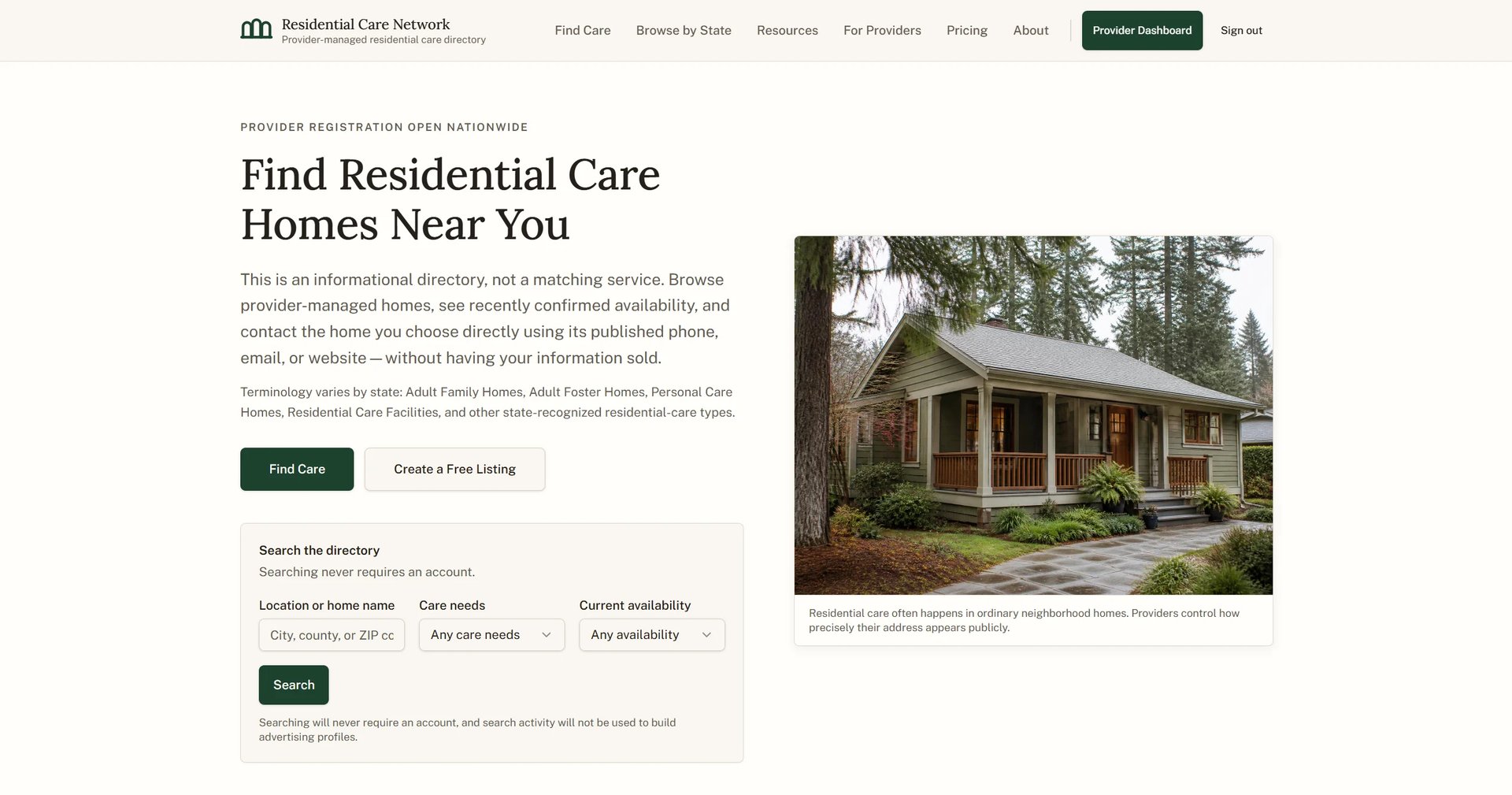
Browsable state and location directories for finding care by region.
Location pages that narrow the search to a specific area.
Each provider home gets its own public profile with the information families need.
Families reach providers directly, with no referral layer in between.
Listings show availability where displayed, alongside real imagery of the home.
Updates providers publish so families see the latest from each home.
Providers keep their own information current — no waiting on an administrator for every small update.
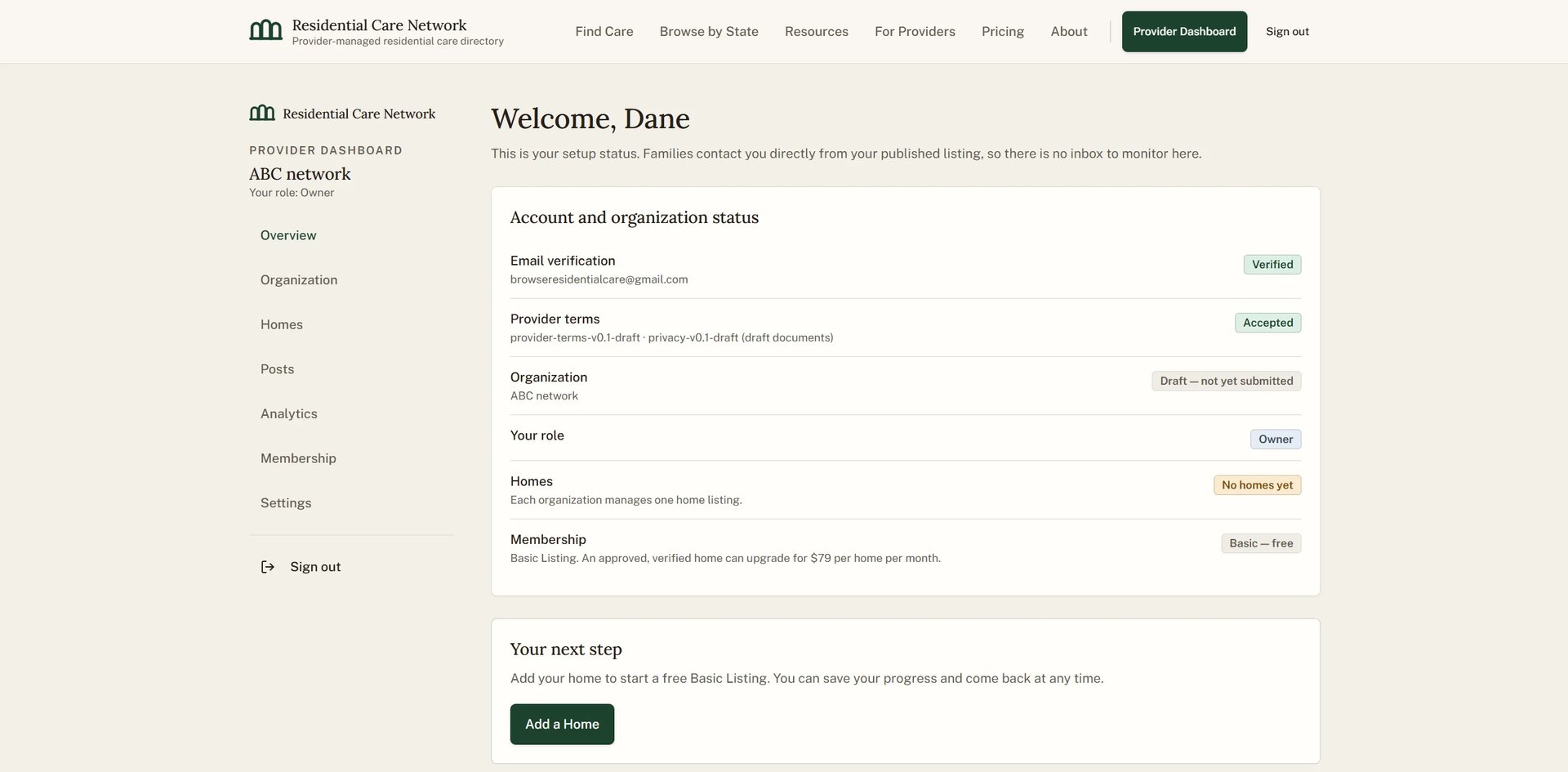
Providers sign in to a dedicated account area for their organization and homes.
A single provider can manage an organization and its associated home listings.
Providers update their own public profile information directly.
Upload and manage imagery so families see each home accurately.
Keep current openings visible so families see accurate availability.
Publish updates and manage listing level where appropriate.
A directory is only as useful as the trust families can place in it. The platform includes a workflow for keeping listings legitimate — let me walk through how it actually works.
A documented workflow for providers to submit business and licensing information for review before a listing is approved.
An administrator reviews and moderates listings before they go public, so the directory stays clean.
Tools for resolving disputes over who legitimately controls a given home listing.
Administrator control over account and listing status, from active to removed.
Only information intended to be public is ever shown publicly; verification and account data stays private.
Residential Care Network's architecture was built to support care providers across all 50 states — with room for the directory to expand as more providers join.
Built to support a national footprint, plus Washington, D.C.
Each state gets its own directory level for regional browsing.
City-level pages narrow the search to specific communities.
Each provider home resolves to its own dedicated profile page.
Location-based architecture designed around how families actually search for care.
The structure is designed to scale as the provider base grows.
Residential Care Network is not a referral service, and it doesn't charge a fee when a family finds a home. Families contact providers directly, and providers control their own public listings.
Providers can maintain a basic presence without Residential Care Network taking a referral fee. Optional paid listing features create a direct subscription model rather than charging based on resident placement.
Providers can maintain a basic presence without paying.
Providers can choose additional visibility and features on a recurring subscription basis.
Paid listing subscriptions are handled through Stripe recurring billing.
A platform like this holds different kinds of information, and they shouldn't all be treated the same way.
What families should see: home profiles, photos, availability, and contact details.
Information providers manage themselves, kept separate from what's public.
Documents and licensing information used for review — never public.
Account, moderation, and payment information kept strictly private.
The point isn't to expose the inner workings — it's that the platform was structured thoughtfully, with a clear separation between what families see, what providers control, and what stays behind the scenes.
The visual design was only one part of the build. The larger challenge was making all of those pieces work together as one usable platform.
Residential Care Network launched as a functioning national directory platform with provider-managed listings, administrative controls, and infrastructure designed to expand as more providers join.
If you're trying to build something with directories, accounts, user-managed content, subscriptions, or functionality beyond a traditional business website, tell me what you're working on. I'll take a look and tell you whether it's something I can realistically help build.